🌐 Professional Aesthetic Equipment Manufacturer | Global Supply | CE Certified


The Real Total Cost of Owning an Aesthetic Device: What Buyers Miss Beyond the Sticker Price

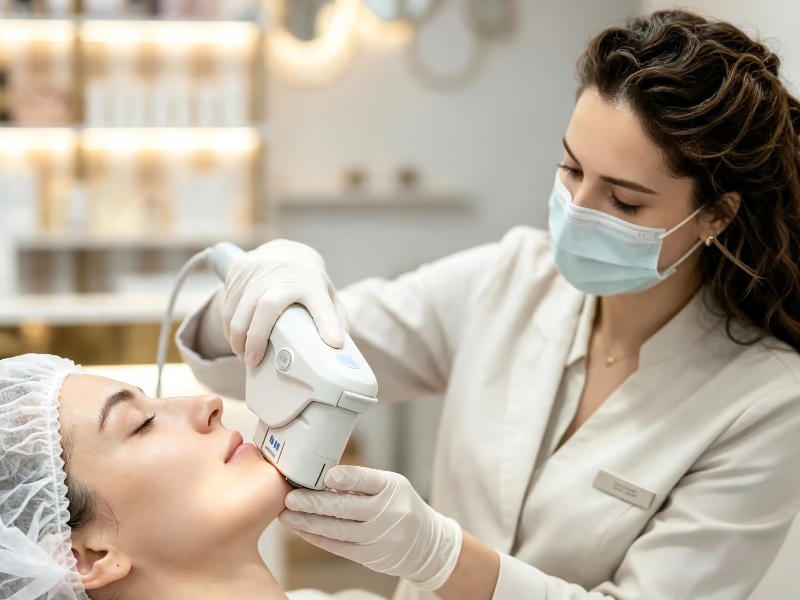
A $6,000 HIFU machine and a $9,000 HIFU machine can end up costing almost the same amount over three years — or wildly different amounts. The purchase price is the number every buyer negotiates hardest on, yet it’s usually only 30–40% of what the device actually costs to run. If you’re comparing quotes from two or three factories right now, the sticker price is the least useful number on the page.
This is where total cost of ownership (TCO) comes in. TCO is simply every dollar a device will cost you from the day it lands in your clinic to the day you retire it — not just the invoice you pay upfront.
Why Sticker Price Misleads B2B Buyers
Two suppliers can quote the same headline price for a similar-spec machine and still leave you with completely different five-year costs. The gap usually hides in things that don’t show up on a quotation: how often the handpiece needs replacing, whether the cooling system needs annual servicing, how long a spare part takes to ship from the factory, and what the warranty actually covers versus what it excludes in fine print.

Buyers who’ve already gone through the work of matching devices to their salon’s positioning often assume the hard part is done once they’ve picked the right technology. In reality, picking the right technology and picking the right total cost are two separate exercises.
The 6 Cost Categories That Make Up TCO

1. Consumables and cartridges. HIFU cartridges, pico laser filters, and RF tips wear out with use. Ask for the shot count per cartridge and the reorder price — not just “how many treatments,” which suppliers often round generously.
2. Downtime cost. Every day a device is out of service is a day of lost bookings. If your supplier’s average repair turnaround is 3 weeks versus a competitor’s 5 days, multiply that gap by your average daily revenue per device.
3. Training and re-training. Staff turnover means retraining. Confirm whether follow-up training sessions (after the first free one) are chargeable, and in what format — video call, on-site, or paid documentation only.
4. Spare parts pricing and availability. Ask for a written spare parts price list up front, not “contact us when needed.” Suppliers that hesitate to share this are usually the ones who mark parts up later.
5. Warranty terms — read the exclusions. A “18-month warranty” that excludes handpieces, lamps, or cooling components is a very different warranty from one that doesn’t. Get the exclusion list in writing before you order.
6. Shipping, duties, and reshipping costs for parts. A part that’s cheap in USD can become expensive once air freight and customs duties are added for a single replacement item.
A Simple Way to Compare Two Quotes
When you’re down to two finalist suppliers, build a basic 3-year cost table: purchase price + (annual consumable cost × 3) + (estimated downtime days × daily revenue loss) + (training costs) − (resale value, if any). The supplier with the lower number — not the lower invoice — is the better deal.
This is also the moment to revisit how the supplier was vetted for legitimacy and manufacturing quality — a supplier that fails transparency checks on manufacturing is statistically more likely to be vague about long-term costs too.
Ask These Questions Before You Sign
- What is the exact cost and shot-life of each consumable/cartridge?
- What does the warranty exclude, in writing?
- What is the average parts shipping time to my country?
- Is remote troubleshooting included, or billed per session?
- Can you provide 2–3 references from buyers who’ve owned this model for 2+ years?
A device that looks 30% more expensive on paper but answers all five of these questions clearly is very often the cheaper machine over three years.
If you’re a salon owner, clinic manager or beauty distributor sourcing aesthetic machines for your business, never finalize a purchase based solely on upfront pricing. Full transparency of total cost of ownership determines your long-term profit space.
At Velofrost, we fully disclose all spare parts prices, cartridge costs, warranty coverage and global after-sales response time for every machine model, including our HIFU, cryolipolysis and laser devices. We also provide free one-on-one remote training and written warranty clauses with clear exclusion terms for all partners worldwide.
Contact our sales team to receive a full transparent quotation, official spare parts price list and customized TCO comparison sheet tailored to your local salon scale and target market.
Contact for Inquiry
• WA/Wechat: +852 90462511
• Email: susie@velofrost.com